

Peerceptiv embeds structured peer review into real work to build capability and generate measurable evidence of behavior change.
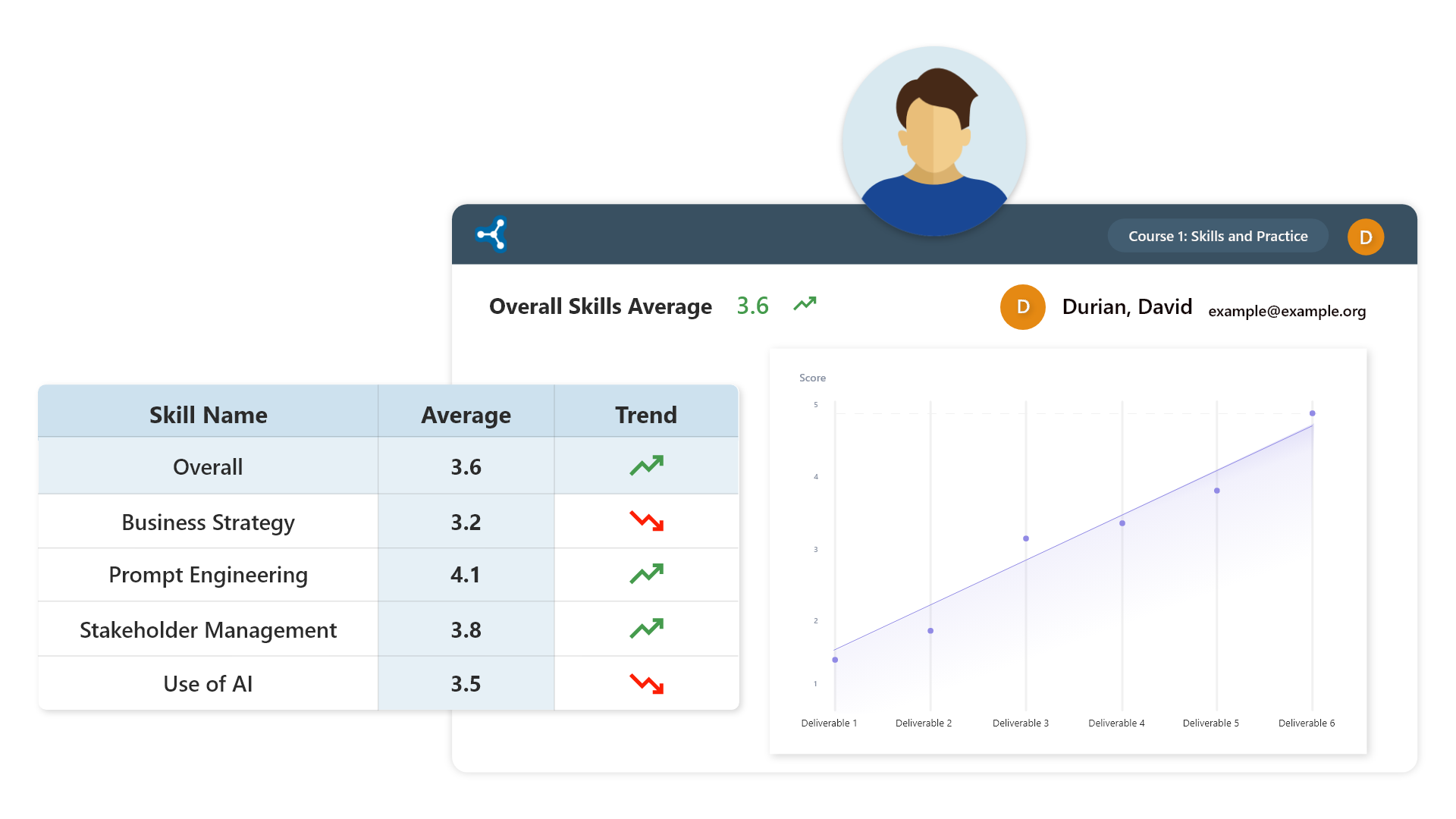
How Peerceptiv Works

Participants apply what they're learning to real work: a training exercise, a project, or their day-to-day role.

Peers review that work and deliver structured feedback aligned to targeted skills and competencies.

Organizations gain measurable data on skill growth and behavior change over time.




For more than two decades, researchers at the University of Pittsburgh studied a simple question: what actually helps people develop capability? Peerceptiv is the commercial application of those findings.
20,879
Learners Studied
76
Institutions
20+
Years of Research

Reviewing a colleague's work means evaluating it, diagnosing problems, and explaining reasoning — a deeper, more durable form of learning than passively receiving critique.
What this means: the act of reviewing builds real skill in the reviewer, on its own.
Yu & Schunn (2023); Wu & Schunn (2021)

Meta-analyses find a 0.63 average correlation between peer and expert ratings, reaching 0.70 to 0.91 when studies are well designed. Multiple peer reviews closely track expert judgment.
What this means: structured multi-peer review is a credible, scalable stand-in for expert review.
Xiong et al.; Cho, Schunn & Wilson (2006)

When several colleagues independently flag the same issue, people are far more likely to act on it. Employees revising work from multiple peers improved more than those coached by one expert.
What this means: routing work to multiple reviewers raises the odds feedback actually changes behavior.
Wu & Schunn (2020); Patchan, Charney & Schunn (2009)

Multiple meta-analyses confirm structured peer review produces measurable performance gains that transfer over time, strengthening critical thinking and feedback skills.
What this means: peer review engages the whole workforce as developers of each other's capability.
Yu & Schunn (2023); Li et al. (2020, 2021); Double et al. (2020)
Learning transfer is what happens when people take what they learned in training and use it in their work. It happens after training ends, which is why a survey or quiz can’t capture it. In Kirkpatrick terms, transfer is the bridge from Level 2 (Learning) to Level 3 (Behavior), and that’s exactly where most measurement stops.
Share of organizations that evaluate training at each Kirkpatrick level. Source: ATD Research, Effective Evaluation: Measuring Learning Programs for Success (2019)
Because business results depend on behavior change, the gap at Level 3 means Level 4 remains invisible.
See exactly where your organization sits on the Kirkpatrick curve.
Most learning programs stop measuring the moment a course ends. Here's the shift that changes everything after it.
"Tell me what you learned."
"Show me what you can do."
Peerceptiv operationalizes this at enterprise scale, capturing structured, timestamped evidence every time employees review one another's real work.
The research holds up in the workplace. Here’s what structured peer review looks like at enterprise scale.
Of 58 skills tracked across multiple assignments
Of those show measurable growth (32 of 43)
Skills tracked across multiple courses
Source: Peerceptiv customer data, Fortune 100 insurer deployment